
MPP Update - April 2026
From campus to campus, a deeper look into my critic tour last month!
A Message from your MPP
As the semester comes to a close and students across Ontario are finishing up their exams, it’s a time of both reflection and transition. Campuses are busy with final papers, late nights of studying, and the anticipation of a well-earned summer break. For many students, however, this period also brings added stress, not only academically, but also financially, as they balance the rising cost of living, tuition, and growing uncertainty about the future.
In my role as Critic for Colleges, Training, and Universities, I’ve spent the past several months visiting campuses across the province, speaking directly with students, faculty, and campus staff about these challenges. These conversations have reinforced just how critical this moment is for postsecondary education in Ontario. While students may be preparing to step away from the classroom for the summer, the issues they are facing don’t pause, and neither does my work.
As the session at Queen’s Park continues, I remain focused on advocating for a system that puts students first: one that protects access to education, addresses affordability, and ensures every student has the support they need to succeed. The stories and perspectives I’ve heard on campuses will continue to guide my work in the months ahead, as I push for meaningful action and real solutions.
Local Matters Tour: Visiting Colleges and Universities Across Ontario
Over the past few months, I’ve continued with the second leg of my Local Matters Tour, travelling to campuses across Ontario as part of my work as Critic for Colleges, Training, and Universities. These visits have been an important opportunity to hear directly from students, faculty, and campus organizations at a time when the postsecondary sector is facing significant uncertainty.
What I’ve heard has been consistent across the province: Students are feeling the pressure of rising costs, growing debt, and increasing uncertainty about their future. Recent changes to OSAP, which shift more financial support toward loans and away from grants, are only adding to that stress.
My tour began at Humber College, where I met with IGNITE, the student union representing over 30,000 students. We discussed the very real implications of policy changes, such as Bill 33, which allows the province to declare certain student union fees optional, threatening funding for key campus services. At Humber, student fees support programs like health and dental coverage, food banks, transit, wellness spaces, and tax clinics. The ability to make these fees optional puts these student-led services and the people who rely on them at risk.


At McMaster University, I had the opportunity to meet with both faculty and students and hear different perspectives on the changes happening within our system. I toured their nuclear research reactor, a globally recognized facility that plays a key role in research for many sectors, including mining and the environment. They are also leading the world in the production of iodine-125, a medical isotope used in the treatment of prostate cancer. It’s a strong example of the kind of innovation happening right here in Ontario, and why continued investment in our postsecondary institutions is so critical.
Equally important were my conversations with students and student leaders at McMaster. Many shared concerns about rising costs, growing debt, and the long-term impact of recent OSAP changes. For some, these shifts are already influencing decisions about whether to pursue or continue their education. These are not abstract policy changes - they are having real consequences on students’ lives and futures. Postsecondary education is an investment in our future, and it’s one that the province should support, not make harder to access.


My final stop was at Brock University in St. Catharines, where I met with both student representatives and faculty. Once again, concerns around OSAP and Bill 33 were at the forefront of our discussions. Student associations highlighted how these changes could undermine services on and off campus. What stood out to me is that the student government at Brock University fully funds 4 out of the 6 bus routes in Thorold. This really highlights how Bill 33 doesn’t just impact postsecondary institutions; it sets off a chain reaction in the local economy, putting pressure on transit systems, local partnerships, and essential services that communities rely on well beyond campus.
While at Brock, I also visited their Nursing Simulation Labs, where students train using advanced technologies to prepare for real-world clinical environments. As a registered nurse, this was a particularly meaningful stop for me. I was able to see firsthand the innovative, hands-on training students receive, including the use of virtual reality (VR) and extended reality (XR) tools that help build confidence and clinical skills before entering real-world settings. It was incredibly encouraging to see how this kind of training is helping shape the next generation of healthcare professionals and strengthening our healthcare system here in Ontario.


Finally, I met with faculty at the Cool Climate Oenology and Viticulture Institute (CCOVI) at Brock University. Their innovation is driving Niagara’s success as a world-class wine region, grafting European varieties of grapes onto North American root systems, combining the resilience of local plants with the flavour profiles of international wines. It brought me back to my undergrad days at Trent University, where I majored in biology!
This is also a big reason why the wine industry in the “Niagara Cluster” contributes over $1 billion to Canada’s GDP. Their work is deeply collaborative with local growers, helping ensure strong, reliable harvests, because a poor crop here wouldn’t just hurt Niagara, it could have serious consequences for the entire Canadian wine industry.


Across every campus, one thing is clear: students want to be heard, and they deserve a system that supports them. I’ll continue bringing these voices back to Queen’s Park and pushing for a postsecondary system that is accessible, affordable, and built for the realities students are facing today.
Upcoming Events and Community News

Vigil for Peter Clark - May 3rd, 2026
A community vigil for Peter Clark, our crossing guard who was tragically killed on duty last month at Cedarview and Kennevale, will be held on Sunday, May 3, at 2:00 pm, at Weybridge Park. A table and stationery will be available for those who’d like to share a memory.
If needed, the rain date will be Saturday, May 9, at the same time and location.

Financial Empowerment Event
An opportunity for young women to explore financial literacy and careers in finance through interactive activities, real conversations, and mentorship from professionals in the field. The event will take place on Saturday, May 2, 2026, at Walter Baker Centre (Halls A/B) from 10:00 a.m. – 2:00 p.m.
This event is free to attend and includes lunch. Registration Required.
Participants will have the opportunity to hear from women in finance during a live panel, take part in an interactive financial workshop, and engage in small-group speed mentoring. Registration is limited to 100 participants. Register here:
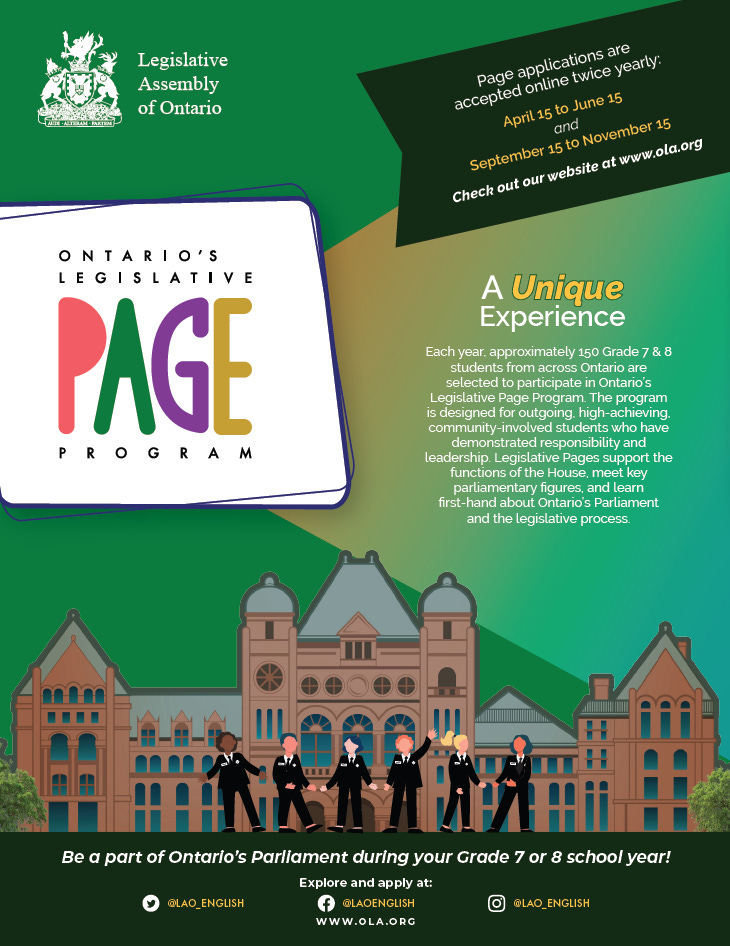
Applications now open for the Page Program:
Ontario’s Legislative Page Program is now accepting applications for the Fall 2026 session - a unique opportunity for students in Grades 7 & 8 to experience Parliament firsthand. For more information, visit the Legislative Assembly of Ontario’s website at www.ola.org or contact pageprogram@ola.org.
As always, if you would like me to attend your event in our riding, or if you would like your event posted in our newsletter, please reach out to my constituency office email - tylerwatt.mpp.co@ola.org. We are always here to help and engage in the community!
Thanks for reading! I hope you enjoyed this newsletter. Send it to a friend and have them sign up to receive one in their inbox next week!